For those who don’t want to read long chunks of text, I’ve recorded a voice-over:
For me, the past year has largely revolved around AI issues affecting both large companies and small studios. I have compiled my notes and observations from the past year in this article. It is a snapshot of how I currently view AI.
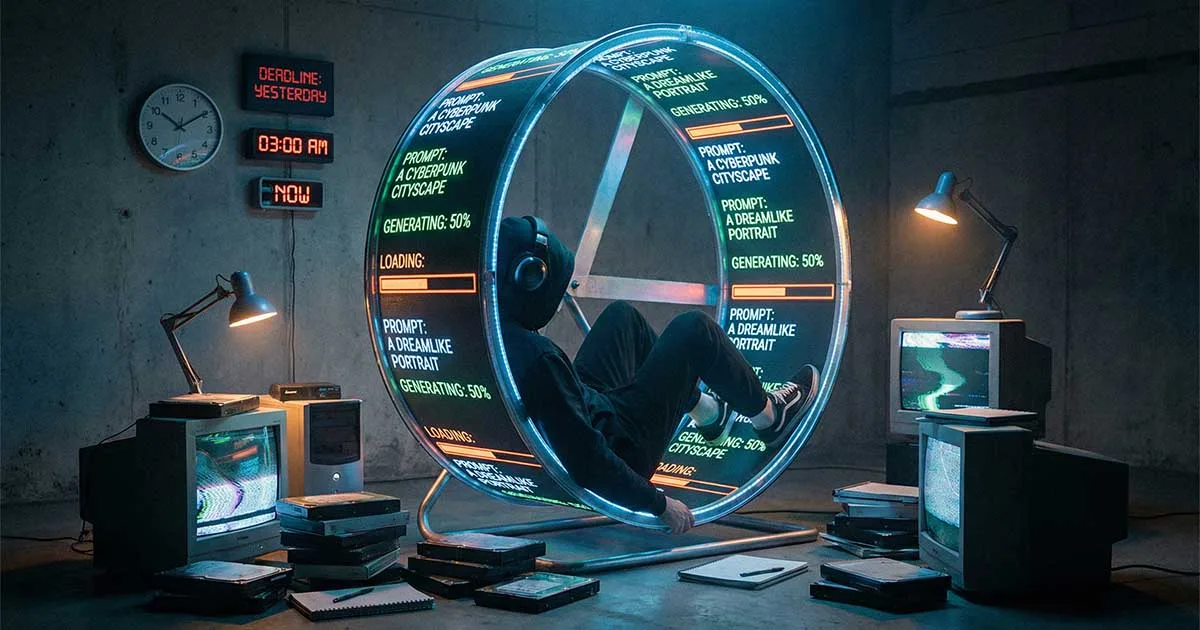
The promise was clear: AI tools would automate the tedious, repetitive tasks so that we, the creators, would have time left over for meaningful work. But 2025 revealed a different reality. Creatives weren’t freer, but actually busier; dealing with endless iterations, escalating client requests and managing a whole new category of digital noise. Are we really rethinking the creative process in the right way?
As well as the age-old question “will you still have a job in the future?”, we were constantly told that AI would save time. And on a micro level, I think that’s true. Designers have been using AI systems for years, consciously or unconsciously; the content-aware tools in Photoshop were already ‘AI-supercharged’ long before DALL-E appeared.
Still, Sam Altman’s mantra bothers me: “AI tools won’t replace your job, but someone using them most likely will.” Why does this strike a nerve? Because it suggests that we are merely task-churning operatives who, with AI, can tick off to-do lists even faster. Anyone who says this fundamentally underestimates what a creative’s work entails.
The argument is that the time saved can be spent on the most stimulating aspect of our profession: thinking. Various studies suggest that this productivity hypothesis may well be correct [1, 2, 3]. But do we see this in practice? Are creative professionals now sitting back to think deeply whilst the AI does the work? The anecdotal evidence screams ‘no’.
A clear tension has arisen. Companies see AI as a means of boosting profits: more output in fewer hours. ‘Profit first’ seems to dominate the creative industry. The danger is that if we go along with this, we will become complacent in finding genuine, creative solutions for the long term.
There is as yet no evidence that AI has actually given us more time. The market simply expects more, and faster. Because a video can now be generated in 30 seconds, deadlines are being brought forward. But our mental capacity to let ideas mature has not increased; it remains the same.
If you ask me whether I’m doing more work than I was two years ago: yes, a lot more. I’m busier than ever. Do I earn more as well? No, that’s remained pretty much the same. The headline in *The Wall Street Journal* hit the nail on the head: “Your Prize for Saving Time at Work With AI? More Work.” [4]. As soon as production capacity becomes available, the market demands it immediately.
Furthermore, recent studies show that we miss the friction of the ‘old’ process. It was precisely those frustrating tasks that forced us to be creative. Researchers at Santa Clara University [5] asked participants to come up with ideas, with one group permitted to use ChatGPT. This group came up with more detailed ideas, but felt less connected to them. A common piece of feedback was therefore: “ChatGPT allowed me to switch off my brain,” and it reduced their confidence in coming up with ideas themselves.
That creative struggle, however frustrating it may be, turns out to be essential for fulfilment and a sense of ownership. The distinction between what we should automate and what deserves our human attention has become blurred.
It is very tempting to outsource our entire thought process – from analysis to intuition – to this new system. And whilst AI can be a fantastic driver for the rational side of creativity, the work only truly comes into its own when our emotional intelligence is given the space to delve deeper.
What I’m seeing happen around me speaks volumes: AI helps good designers get better, and bad designers get worse more quickly. The art of our profession lies not in the tools, but in our problem-solving skills and the wisdom to know when to use AI.
Will 2026 mark a turning point in how we use AI and what customers expect from us? We’ll have to wait and see.